




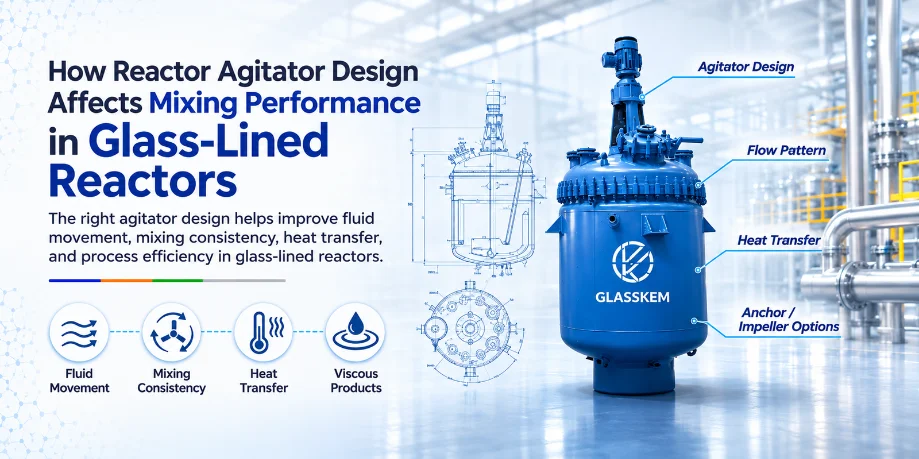
Mixing is a central part of many chemical and pharmaceutical processes. The agitator inside a reactor influences how materials move, blend, and interact during processing. In a glass-lined reactor, selecting the right glass lined reactor agitator requires consideration of the process, fluid properties, reactor configuration, and intended mixing objective rather than treating one arrangement as suitable for every application.
Glasskem offers glass-lined reactor configurations with different agitator and baffle arrangements to suit varying process requirements. Its AE-type reactors, for example, can be equipped with universal impeller-type or anchor-type agitators.
Why Agitator Design Matters in Glass-Lined Reactors
An agitator creates movement within the reactor and helps distribute the materials being processed. Its configuration can influence the flow pattern and the way the contents circulate throughout the vessel. Depending on the process, effective agitation can support:
- Fluid movement: Helps maintain circulation within the vessel.
- Mixing consistency: Supports more uniform distribution of process materials.
- Heat transfer: Agitation can help distribute heat through the batch.
- Suspension: Appropriate mixing can help keep solid materials distributed where required.
- Reaction uniformity: Consistent movement can support more even process conditions.
The actual mixing requirement depends on the material and process, so agitator selection needs to be considered as part of the complete reactor design.
Understanding Reactor Agitator Design
Reactor agitator design involves more than simply selecting a rotating component. The impeller arrangement, shaft configuration, reactor geometry, fluid properties, and required mixing pattern all influence how the system performs.
Glasskem's AE-type reactors include an agitator, baffle, drive system, gearbox, and mechanical seal as part of the reactor system. The company offers a standard universal impeller-type agitator and optional anchor-type agitators for viscous products. This integrated approach allows the agitation system to be considered alongside the vessel and its operating requirements.
How Agitator Design Influences Mixing Efficiency
The right mixing arrangement can improve the distribution of materials within a reactor, but the meaning of "mixing efficiency" depends on the application. Factors such as fluid viscosity, solids content, density differences, reaction requirements, heat-transfer needs, and the desired flow pattern all affect agitator selection.
For example, Glasskem describes its anchor agitator as suitable for highly viscous or paste-like materials. The anchor-shaped blades sweep the vessel walls and are intended to support mixing and heat transfer while helping prevent material buildup on the walls. This illustrates why agitator selection should be based on the characteristics of the material being processed rather than on a single standard design.
Impeller Selection and Its Role
Impeller selection influences the type of movement generated inside the reactor. Different geometries can produce different flow patterns and levels of shear, making them suitable for different process objectives. Glasskem lists universal impeller-type agitators as standard configurations on its AE-type reactors and also provides anchor-type options for high-viscosity applications. Its anchor agitator is described as producing predominantly tangential flow with low shear and being suitable for non-Newtonian fluids and thermal-transfer applications. There is no single impeller arrangement that is ideal for every process. Final selection should be based on the actual process requirements and engineering evaluation.
Glass-Lined Reactor Mixing Considerations
Glass-lined reactor mixing needs to consider both the process and the equipment configuration. The agitator, baffles, shaft, mechanical seal, and reactor geometry work together as part of the mixing system.
Glasskem's reactor configurations include paddle-type and multifunction baffles. On larger AE reactors, the multifunction baffle can also provide flow disturbance, immersion-tube functionality, and temperature measurement functions.
Proper equipment configuration is therefore important when specifying an agitator for a glass-lined vessel.
Factors to Consider When Selecting an Agitator
Process engineers should consider:
- Fluid viscosity
- Product characteristics
- Solids or suspended materials
- Required mixing pattern
- Reaction requirements
- Heat-transfer requirements
- Reactor geometry
- Operating conditions
- Agitator and impeller configuration
- Manufacturer recommendations
These factors help define the type of agitation system required without relying on unsupported assumptions about speed, power, dimensions, or mixing time.
Why Manufacturer Expertise Matters?
Agitator selection is closely connected to reactor design. An experienced manufacturer can evaluate the relationship between vessel configuration, agitation requirements, process conditions, and available equipment options. Glasskem manufactures glass-lined reactors with different agitator configurations, including universal impeller and anchor-type arrangements, and offers customized solutions based on plant and process requirements.
Conclusion
Agitator design has a direct role in how materials move and mix inside a glass-lined reactor. The appropriate configuration depends on factors such as viscosity, solids content, process requirements, heat-transfer needs, reactor geometry, and the desired mixing pattern. Rather than selecting an agitator based on a standard configuration alone, process requirements should guide the equipment specification. Glasskem offers glass-lined reactors and agitator configurations designed around different processing requirements, supported by its equipment engineering and manufacturing capabilities.