




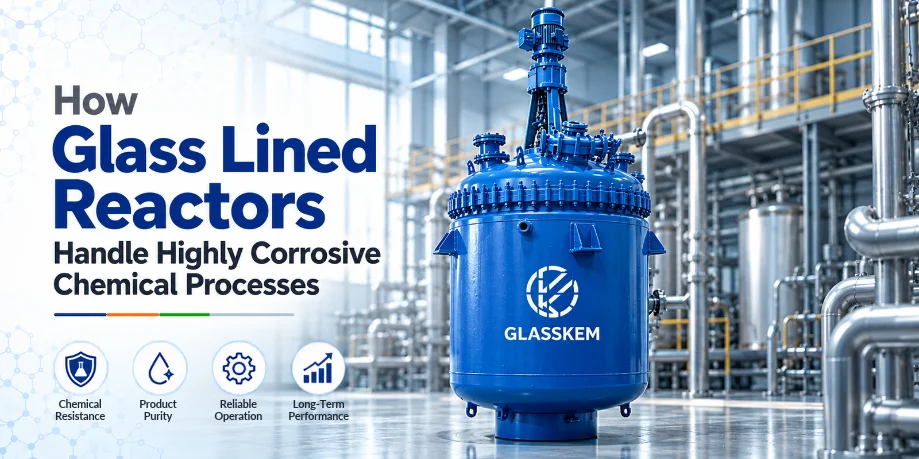
Processing highly corrosive chemicals puts considerable demands on process equipment. The reactor must provide a suitable environment for the reaction while the materials in contact with the process media need to withstand chemical attack. This makes material selection an important part of equipment design.
A glass lined reactor for chemicals is built to pair a strong metal reactor body with a highly resistant glass lined interior. Glasskem manufactures glass lined reactors for the chemical, pharmaceutical, specialty chemical, food, and other process industries.
Why Corrosive Chemicals Require Specialized Reactor Equipment
Corrosive chemical processes can damage equipment surfaces especially when harsh materials are used in operating conditions. Choosing a reactor is therefore not about picking the right size. You must think about chemical compatibility, operating temperature and pressure, mixing requirements, the reactor shape and the final use.
A corrosion resistant reactor provides a protected environment where chemical attack is a constant concern. It protects the process and keeps everything running smoothly. Glass lined construction is particularly relevant because the process material comes into contact with the glass surface rather than directly with the underlying metal construction.
How Glass Lining Helps in Corrosive Chemical Processing
Glass lining acts as a barrier between the process material and the reactor's structural body. Glasskem describes its glass lined reactors as combining the strength of steel with the chemical resistance of glass making them suitable for corrosive and sensitive processes.
The smooth glass surface also supports product purity and helps protect against contamination. Glasskem's product range includes different reactor constructions and glass options intended for varying process requirements. Its glass series includes options such as GK Sigma Blue Glass, GK Phi Pharma Glass, GK Delta Glass, GK Alpha White Glass, and GK ABR Plus.
This combination makes glass lined equipment suitable for applications where chemical resistance, process safety, and reliable operation are important.
Key Features of Glass Lined Reactors
Glasskem offers both mild-steel and stainless-steel glass lined reactor configurations, including AE and CE types. Depending on the model, the reactors can incorporate different agitation arrangements, thermowell options, baffles, jackets, valves, and other process accessories.
Key characteristics available across the product range include:
- Glass lined internal surfaces for chemical resistance and product purity.
- Different reactor configurations to suit varying process requirements.
- Agitation options for controlled mixing.
- Heating and cooling arrangements, including jacketed configurations.
- Customizable designs based on plant and process requirements.
- Instrumentation and process-control options for monitoring operating parameters.
For example, Glasskem's MS AE reactor includes a vessel, agitator, baffle, drive system, gearbox, mechanical seal, and associated accessories, while its CE reactor uses a monoblock construction and can be configured for different production, temperature, and agitation requirements.
- Design temperature: -25 °C to +200 °C
- Design pressure, vessel and jacket: -1 to +6 bar (full vacuum to 6 bar)
- Glass lining thickness: 1.0–2.2 mm
- Capacities: 250 L to 6.3 KL, model-dependent
- Configurations: Mild-steel or stainless-steel shells; AE (open, flanged) and CE (closed) types
- Design standards: DIN 28136, ASME
- Glass systems: GK Sigma Blue, GK Phi Pharma, GK Delta (high-temperature), GK Alpha White, GK ABR Plus
- Heating and cooling: Jacketed configurations, including single-piece jacket
- Agitation: Impeller or anchor agitators with mechanical seal; baffles and thermowell options
Applications of Glass Lined Reactors in Chemical Processing
Glass lined reactors are used across processes where controlled chemical reactions, mixing, and resistance to aggressive process media are important. Their application extends across several industries and process environments, including:
- Chemical Manufacturing: For chemical reactions and processing where the materials require a resistant reactor surface.
- Pharmaceutical Manufacturing: Ideal for processes that need tight reaction control, high product purity, and strong protection against contamination.
- Specialty Chemicals: For reaction conditions and tough chemical materials where the right process equipment must be matched to demanding service.
- Research & Development: Used in laboratory and process-development work for evaluating reactions, developing formulations, and studying processes before further scale-up.
- Corrosive Chemical Processing: A glass lined reactor for corrosive chemicals provides a glass lined process-contact surface that can be useful when handling aggressive chemical materials.
- Process Industries: Glass lined reactors can be incorporated into industrial chemical processing equipment where mixing, reaction control, heating, or cooling are part of the process.
- Food Processing Applications: Glass lined reactor solutions can also be used in selected food-processing environments where the properties of the glass lined surface are appropriate for the process requirements.
Benefits of Glass Lined Equipment for Corrosive Processes
Choosing suitable glass lined equipment can offer several practical benefits:
- Corrosion resistance: The glass lining provides a chemically resistant process-contact surface.
- Product purity: The glass surface supports applications where contamination control is important.
- Process flexibility: Different reactor types and configurations allow equipment to be matched to process requirements.
- Controlled mixing: Available agitation arrangements support different mixing requirements.
- Customization: Glasskem provides configurable solutions for specialized plant requirements.
Actual suitability, however, depends on the chemicals, operating conditions, and process configuration involved.
Choosing the Right Reactor for a Corrosive Chemical Process
Before selecting a reactor, engineers and procurement teams should evaluate the complete process. Consider the chemicals being processed, required capacity, operating temperature and pressure, mixing requirements, heating or cooling needs, reactor configuration, and the required glass-lining system.
The manufacturer's engineering capability is equally relevant. A reactor should be selected according to the actual process rather than relying on generic equipment specifications.
Why Manufacturer Selection Matters
Glass lined equipment requires careful engineering, manufacturing, and quality control. Having experience with reactor setups, glass systems and process needs can make sure the equipment picked fits well with what it is meant to do.
Glasskem manufactures glass lined equipment for chemical, pharmaceutical, food, and other process industries, with reactor solutions available in multiple configurations and customized designs.
Conclusion
Highly corrosive chemical processes require thoughtful equipment selection, particularly where chemical compatibility, product purity, and reliable processing are priorities. A properly selected glass lined reactor for corrosive chemicals can provide a practical combination of structural strength and a chemically resistant glass lined process surface.