




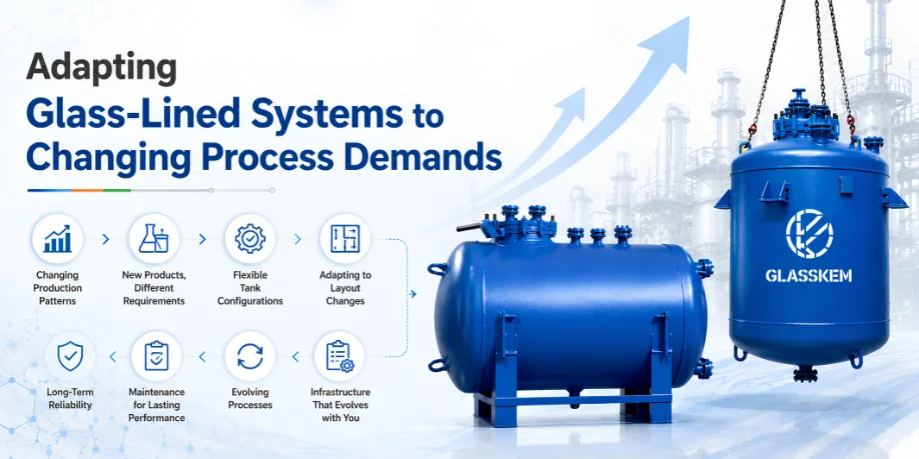
A holding vessel that once matched the process perfectly may eventually find itself supporting a very different operation. New products enter the line. Production targets shift. Over time, extra process stages get bolted on.
When backlogs start piling up around storage and transfer points, it rarely means the original equipment decision was wrong.
It usually just reflects reality. Processes evolve. To accommodate these changes, the containment systems supporting the line have to evolve right along with them.
Process Requirements Rarely Stay the Same
Day one operations rarely look like day one thousand. Production targets shift. New products drop into the line. Extra stages get added to the workflow over time.
These adjustments are just a normal part of running a plant. But they completely change what you need from your holding and transfer equipment.
Changing Production Patterns Influence Storage Requirements
When batch volumes go up or timing changes, a storage arrangement that once handled the process comfortably may eventually face very different demands.
Higher throughput means you need more holding capacity. Appropriately sized glass-lined receivers, available in capacities from 63 L to 20,000 L, give the line the exact volume it needs to handle shifting production patterns.
These vessels help facilities accommodate changing production patterns while maintaining the flexibility needed between process stages.
New Products Often Introduce Different Requirements
Changing the product portfolio completely alters the demands on the hardware. A line built for straightforward fluids might suddenly need to hold heavy powders or granules. Chemical Storage Tanks have to actually handle that switch, offering enough application versatility to adapt to different physical states.
If a facility processes aggressive media like bromine, heavy caustics, or high-purity pharmaceutical products the glass lining offers a chemically resistant barrier that holds up across a broad pH range.
That material flexibility is exactly what lets a plant absorb new product lines without tearing out the entire containment setup.
Layout Modifications Influence Tank Configuration
Floor space disappears fast as processes evolve. Adding a new stage often forces a layout reshuffle, shrinking the physical footprint you have left for storage.
If you have the vertical clearance, a Glass-Lined Vertical Storage Tank maximizes capacity without eating up the floor. To fit the modified space, these tanks use different support structures, including:
- Standard support legs
- Side brackets
- Skirt support designs
If new piping restricts your overhead space instead, a Glass-Lined Horizontal Tank sitting on sturdy saddles safely distributes the load. Similar layout considerations apply when adapting Glass-Lined Storage Systems in Canada, including industrial regions like Alberta, where evolving processes frequently dictate physical storage configurations.
Existing Infrastructure Must Support New Expectations
A process rarely asks the same thing from its equipment year after year. What started as a straightforward holding application may eventually support:
- Different products
- Revised production targets
- Additional stages
- Altered timing requirements
As those expectations change, the role played by Glass-Lined Storage Systems changes with them. This is where facilities often review their existing Storage Tanks & Receivers to ensure the infrastructure continues to align with the operation.
The focus shifts entirely toward making sure the hardware matches the current reality of the floor.
Long-Term Reliability Depends on More Than Initial Installation
Adapting to change is only step one. As production requirements shift, keeping the hardware running dependably matters even more. Fusing a glass lining with robust steel construction gives the equipment the resistance it needs against corrosive contents.
This lets the vessels handle demanding environments, including pressures from full vacuum up to 6 kg/cm² (g) and temperature swings spanning -25°C to 200°C.
But hardware doesn't maintain itself. Reliable long-term operation requires ongoing attention. Understanding practical Glass Lined Equipment Maintenance: Tips and Best Practices ensures the infrastructure remains capable of supporting the process as it evolves.
Adapting Infrastructure Is a Normal Part of Process Evolution
When you treat process changes as a normal part of running a plant, your containment strategy becomes an adaptable network instead of a fixed limitation. Letting storage systems evolve right alongside the production line gives the facility genuine predictability.
A containment system should never be viewed as a static piece of infrastructure. Its role changes over time. Recognizing these shifts early helps facilities adapt without allowing legacy limitations to dictate the way the process operates.
If your facility is managing changing requirements and you need to review your current capacity, Contact Us to discuss the exact dimensions your evolving process demands.